
Interview: eRisk vs. BelVis+ PFM – What is the difference?
13 November 2025
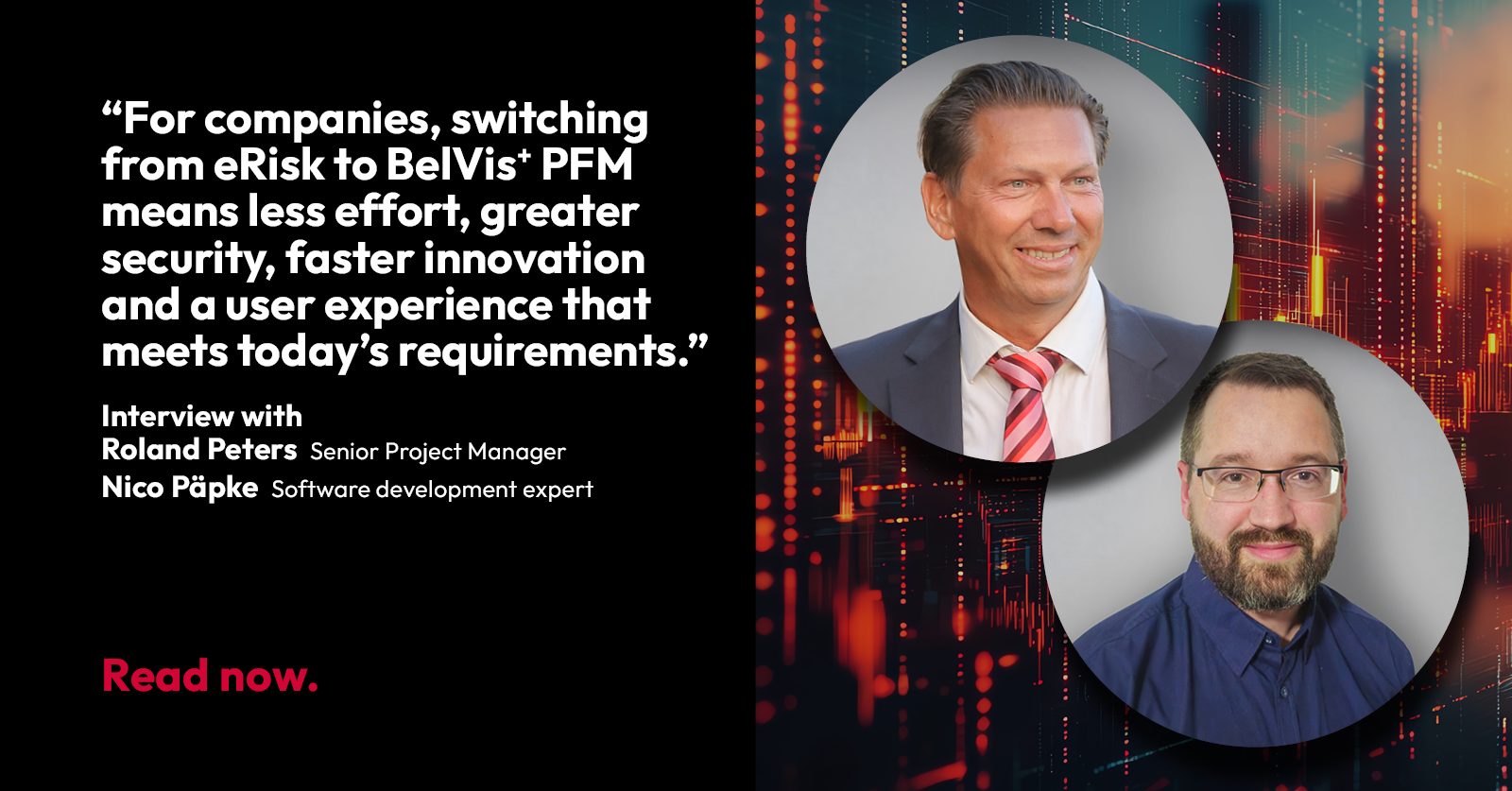
The new KISTERS portfolio management system BelVis+ PFM is the completely redesigned successor to our three existing systems BelVis 3 PFM, eRisk and IRM. What can BelVis+ PFM do better than eRISK and why is it worth switching? Roland Peters, Senior Project Manager, and Nico Päpke, Software Development Expert, explain the benefits of BelVis+ PFM in an interview.
eRisk has been established for years. Why should one switch to BelVis+ PFM?
Roland Peters (RP): From a technical perspective, BelVis+ PFM is a multi-commodity system. Gas, electricity, EUA and other products can be managed in a single system. This is not possible with eRisk, where the processes are highly separate. For companies that serve multiple markets, this is a decisive advantage.
Nico Päpke (NP): eRisk has long been a solid system, but it is based on a classic FAT client architecture. This means that every installation must be done locally, updates are time-consuming and multi-user capability is limited. BelVis+ PFM, on the other hand, relies on a modern client-server architecture with web interfaces. This enables centralised deployments, reduces resource consumption on the clients and makes scaling much easier. It also increases security because no local installations need to be maintained.
What makes the architecture of BelVis+ PFM so special?
NP: The biggest difference is the microservice architecture. While eRisk has a monolithic structure, BelVis+ PFM consists of functionally separate services. This has enormous advantages: we can update, scale or expand individual modules independently of each other. Changes do not have a major impact on the overall system, and new features can be rolled out more quickly. In addition, multiple teams can work on different services in parallel, which shortens development cycles.
RP: This architecture also ensures a high level of reliability. If one module fails, it only affects the corresponding process, not the entire system. Planned updates can be carried out with minimal or even no downtime.
How does this affect scalability and performance?
NP: BelVis+ PFM is container-based and runs on Kubernetes. This means that the software behaves the same for every customer, regardless of the system environment. The platform can automatically scale horizontally depending on the load.
RP: For our customers, this means that performance can be easily controlled via the Kubernetes infrastructure. If necessary, auto-scaling can be activated so that the system automatically provides additional resources. This is a huge advantage over eRisk, where performance is usually limited to the resources of the user’s computer or the application server.
Are there also advantages for users?
NP: Absolutely. BelVis+ PFM offers a modern web interface that not only looks good, but also simplifies operation. No complicated installations, no dependence on local resources. The interface is responsive and allows parallel working with multiple windows. eRisk offers this only to a limited extent.
RP: In addition, users can configure their own dashboards in BelVis+ – across modules and processes. Monitoring is centralised and transparent: all process activities and status messages are visible. Alerts and logging can be set individually at module level. This results in process-oriented monitoring that goes far beyond the capabilities of eRisk. And best of all, the dashboards can be configured to save space, allowing multiple monitors to be used optimally.
What about automation?
RP: This is another major difference. In eRisk, automation is carried out using the old Windows Task Scheduler, which is known to be inflexible and difficult to configure. BelVis+ PFM offers modern time and event automation control that users can operate themselves. Dependent automation configurations are possible, and the focus is clearly on automation and process-oriented monitoring. This saves time and reduces errors.
And the interfaces?
NP: BelVis+ PFM takes an API-first approach. We have REST APIs with clear interface contracts and OAuth2 authentication. This is not only secure, but also easy to integrate. The big advantage over file exchange: REST APIs work in real time. No static CSV files, no manual imports. Processes can be controlled directly and data is available immediately.
RP: REST APIs enable a direct connection to exchanges and other external systems – including feedback after transmission and status evaluation. This ensures greater transparency and speed. Incidentally, the common exchanges and trading platforms are supported out of the box and the customer has no further integration costs.
Are there any advantages in terms of IT security and support?
RP: BelVis+ PFM offers LDAP-based user management with roles and rights per module as well as two-factor authentication. IT security rules are consistently implemented. In addition, there is always up-to-date online help linked to the respective release. Customers receive continuous release notes and CVE (Common Vulnerabilities and Exposures) information in the service portal on the KISTERS website. This is a significant improvement over eRisk.
What is your conclusion?
NP: The switch from eRisk to BelVis+ PFM is more than just a technical upgrade. It is a move away from a monolithic, cumbersome architecture to a flexible, scalable and future-proof platform. For companies, this means less effort, greater security, faster innovation and a user experience that meets today’s requirements.
RP: And from a technical perspective, BelVis+ PFM offers everything modern portfolio managers need: multi-commodity capability, automation, transparent dashboards and an architecture that will still be state of the art in five years’ time.
Learn more about BelVis+ PFM